Seabird
Mariners' Museum, Uncurated Search Results
Type: Pungy
Year: 1854
Builder:
Location:

These records are found in the online catalog of The Mariners’ Museum and Park in Newport News, Virginia. Uncurated search results are presented to give researchers and interested readers an idea of whether the museum’s archives contain information about this vessel and whether it may be worthwhile to visit the museum’s catalog search page for further investigation. Uncurated results may be inaccurate or incomplete.
Search mode: Exact Name. Search phrase(s): "Seabird". Results returned: 25. Results displayed in this table: 25.
Use these buttons to send uncurated search results to your own app or text document for further research. First, check the box for any row, or click "Select All" then uncheck any rows. Then click "Show Selections". You can then copy your selections from the text box and past them into your app.
| Fetch? | Row ID | Media | Date | Vessel | Place | Related Places | Inscription/Marks | Subject | Notes | Archive Number |
|---|---|---|---|---|---|---|---|---|---|---|
| 1 | 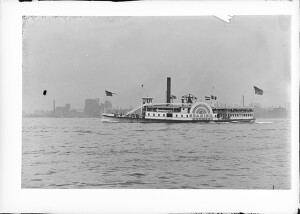 | Before 1929 | Seabird (Side wheel steamer : 1866). | Steamboats–United States.; Bodies of water.; Paddle steamers–United States. | Shows the side-wheel steamer Seabird under way. There is a city on the horizon. | MS0095/02-#132 | ||||
| 2 | No image URL. | Boatbuilding.; Boatbuilders.; Motorboats–Design and construction. | Port Carling Boat Works' 1936 Seabird. | LB91058 | ||||||
| 3 | No image URL. | Contains black-and-white photographs. | MS0817/01-16.149 | |||||||
| 4 | 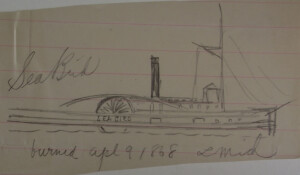 | VESSEL INFORMATION - VESSEL NAME: SEA BIRD VESSEL TYPE: SEABIRD VESSEL BUILT: 1859 BUILDER LOCATION: NEWPORT, MICHIGAN BURNED: APRIL 9, 1868 | CL23000 | |||||||
| 5 | 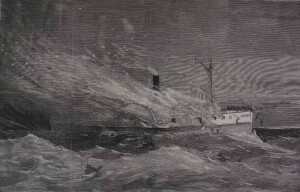 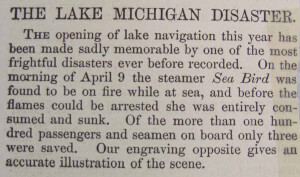 | ADDITIONAL INFORMATION: Harper's Weekly, April 25, 1859. VESSEL INFORMATION: The SEA BIRD was built at Newport, Michigan during 1859. VESSEL INFORMATION - VESSEL NAME: SEA BIRD VESSEL TYPE: SEABIRD VESSEL BUILT: 1859 BUILDER LOCATION: NEWPORT, MICHIGAN BURNED: APRIL 9, 1868 | CL17204 | |||||||
| 6 | No image URL. | S-2 Yachts, Sabre/Sabreline/Sabre Yachts, Scarab Offshore, Scout Boats, SeaBird Yacht Corp., Sea Cat, SeaCraft Inc., Sea Doo, Seafox Yachts, Seagull Boats, Sea Ox, Sea-Pro Boats, Sea Ray | MS0379/-14 | |||||||
| 7 | 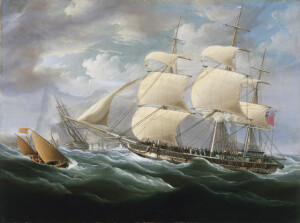 | SHORT DESCRIPTION: Painting by Thomas Buttersworth showing a British frigate entering Gibraltar harbor. | CL8792 | |||||||
| 8 |   | NOTES: Designed by Dr.Hugo A. Myers, the 44' racing catamaran "Sea Bird" held the prestigious Transpac record from Los Angles to Hawaii for 9 years. This "fine entry and exit" model was built and tank tested at the University of Michigan. The Sea Bird held the Ocean Racing Catamaran Association's Trans-Pacific (Los Angeles to Honolulu) record of 8 days, 18.5 hours for nine years. | CL30308 | |||||||
| 9 | 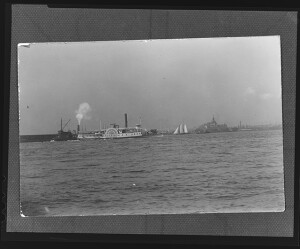 | 7/2/1904 | Steamboats–United States.; Bodies of water–United States.; Paddle steamers–United States. | Shows the side wheel steamer Sea Bird under way. | MS0095/02-#1152 | |||||
| 10 | 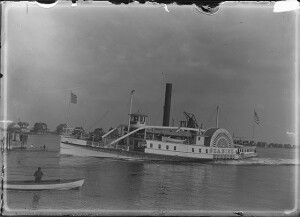 | 8/31/1906 | Steamboats–United States.; Bodies of water–United States.; Paddle steamers–United States. | Shows the side wheel steamer Sea Bird under way. | MS0095/02-#1155 | |||||
| 11 | 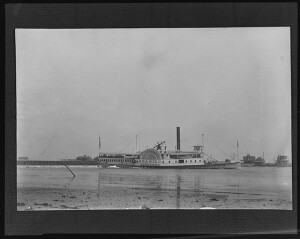 | 8/31/1906 | Steamboats–United States.; Bodies of water–United States.; Paddle steamers–United States. | Shows the side wheel steamer Sea Bird under way. | MS0095/02-#1157 | |||||
| 12 | 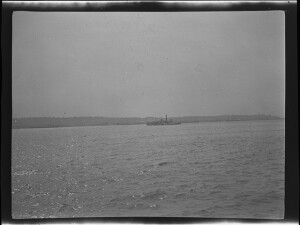 | 9/1915 | Sea Bird (Side wheel steamer : 1866). | Steamboats.; Bodies of water.; Passenger ships.; Paddle steamers. | Broadside veiw of the Sea Bird under way. | MS0091/03.01-87#062 | ||||
| 13 | 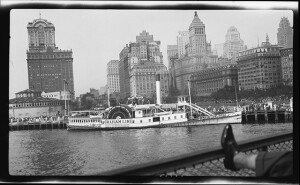 | 9/1915 | Sea Bird (Side wheel steamer : 1866). | Steamboats.; Bodies of water.; Passenger ships. | Broadside veiw of the Sea Bird at pier. | MS0091/03.01-87#063 | ||||
| 14 | 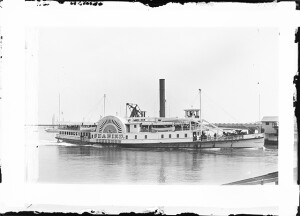 | 7/14/1905 | Steamboats–United States.; Bodies of water–United States.; Paddle steamers–United States. | Shows the side wheel steamer Sea Bird under way. | MS0095/02-#1154 | |||||
| 15 | 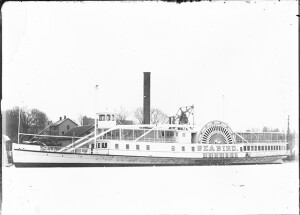 | Circa 1905 | Steamboats–United States.; Bodies of water–United States.; Paddle steamers–United States. | Shows the side wheel steamer Sea Bird under way. | MS0095/02-#1159 | |||||
| 16 | 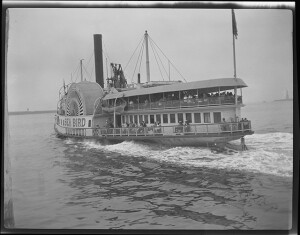 | 9/1915 | Sea Bird (Side wheel steamer : 1866). | Steamboats.; Bodies of water.; Passenger ships.; Paddle steamers. | Stern veiw of the Sea Bird under way. | MS0091/03.01-87#064 | ||||
| 17 | 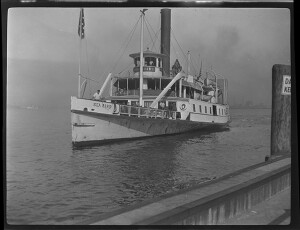 | 9/1915 | Sea Bird (Side wheel steamer : 1866). | Steamboats.; Bodies of water.; Passenger ships.; Paddle steamers. | Bow veiw of the Sea Bird under way. | MS0091/03.01-87#066 | ||||
| 18 | 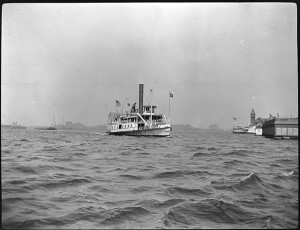 | 9/1915 | Sea Bird (Side wheel steamer : 1866). | Steamboats.; Bodies of water.; Passenger ships.; Paddle steamers. | Bow veiw of the Sea Bird under way. | MS0091/03.01-87#067 | ||||
| 19 | 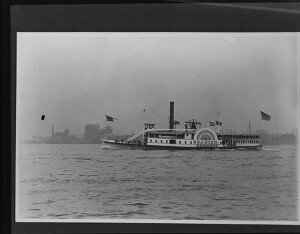 | 7/4/1905 | Steamboats–United States.; Bodies of water–United States.; Paddle steamers–United States. | Shows the side wheel steamer Sea Bird under way. | MS0095/02-#1153 | |||||
| 20 | 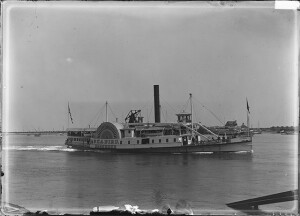 | 8/31/1906 | Steamboats–United States.; Bodies of water–United States.; Paddle steamers–United States. | Shows the side wheel steamer Sea Bird under way. | MS0095/02-#1156 | |||||
| 21 | 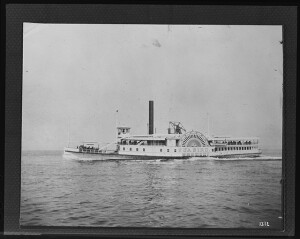 | Circa 1905 | Steamboats–United States.; Bodies of water–United States.; Paddle steamers–United States. | Shows the side wheel steamer Sea Bird under way. | MS0095/02-#1158 | |||||
| 22 | 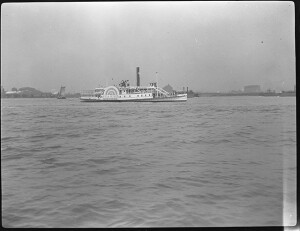 | 9/1915 | Sea Bird (Side wheel steamer : 1866). | Steamboats.; Bodies of water.; Passenger ships.; Paddle steamers. | Broadside veiw of the Sea Bird under way. | MS0091/03.01-87#065 | ||||
| 23 | 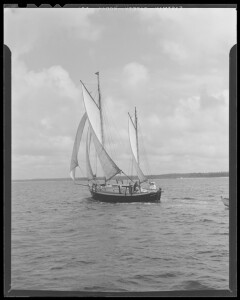 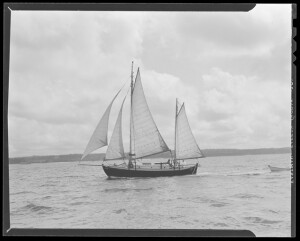 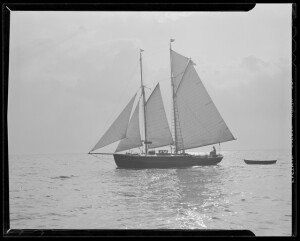 | 1939-1940 | International Star Class Yacht Racing Association–Photographs. | Yachts–Photographs.; Yachting–Photographs.; Yacht racing–Photographs.; Yawls–Photographs.; Schooners–Photographs.; Sloops–Photographs.; Ketches–Photographs.; Sailboats–Photographs.; Motorboats–Photographs.; Tankers–Photographs.; Boaters (Persons)–Photographs. | Contains photographic negatives of the auxiliary ketch Fairwind, the power schooner Sylvia, the auxiliary schooner Windigo, the auxiliary yawl Whitecap, unidentified sloops, unidentified International Star class vessels, the Seawanhaka class vessel Heather, the Seawanhaka class vessel Mist, the Seawanhaka class vessel Wildo, the Victory class vessel Jimmie, unidentified Atlantic Coast class vessels, the International class vessel Mystic, the International class vessel Grisle, unidentified Seabird class vessels, the auxiliary sloop Teal, the tanker M J Derby, the power ketch Bonnie Dundee, four people on the deck of the yawl Cayuga, the power yacht Lucky Strike, the power yacht Streak, unidentified Lightning class vessels, unidentified Handicap class vessels, the Victory class yacht Blue Jacket, the sloop Coquette, and the International class vessel Imp. | P0002.001/50-128 | ||||
| 24 |  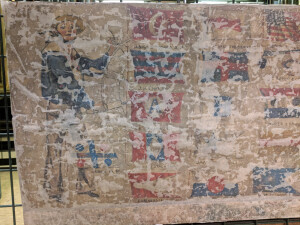 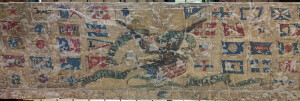 | SHORT DESCRIPTION: Oil painted board covered with white canvas. Sailors stand at either end of the board each holding the spokes of a large steering wheel. There is a large eagle with wings spread over a United States shield. A banner in his beak reads "Private Signals of the Merchants of Boston, Mass. NOTES: Before the advent of the electric telegraph, a system of flag signals was in use, the merchants of Boston having a set of one hundred and twelve private signals, each one a different flag. When a ship arrived, the owner's color was run up at Hull, repeated on an island in the harbor, again shown on Central Wharf, and finally at the old State House. NOTES: The painting appears to be severely overpainted as some of the merchants names are spelled incorrectly. There are photographs in the object file which seem to show the painting undergoing some sort of "restoration" in the shipyard's model shop in the 1930s or 1940s. The painting was faced with tissue and varnish in the 1970s to try and hold the painted surface together. It has remained that way ever since. This may be the original painting from which the well-known lithograph by Kramer & Co. was created from. There are some mistakes in the rendering of the signal flags that may be attributed to the heavy overpaint. For example: in column 7 a rectangular flag with a yellow field and blue dot has no name underneath (T. S. Davis & Co.) and in column 8 the Higgins & Co. flag is portrayed as a rectangular shape with white field and blue dot when its supposed to show a swallowtail shape with white field and blue dot. NOTES: For references below see object file. Iasici, Goddard, & Co. is also spelled Iasigi or Jasigi. The partners were Joseph Jasigi and Thomas A. Goddard. From Joseph’s 1897 obituary, he came to Boston from Armenia in 1830 and formed the partnership. His son, Joseph Andrew Jasigi, was born in 1848 and eventually became a partner. Joseph Andrew went on to be a consul general to Turkey but was arrested for embezzling $220,000, for which he spent 12 years in prison. J. H. Cheney operated in the 1840s and 1850s as a merchant and ship broker. By 1855 he had offices at 4 India wharf. Larkin & Stackpole Co. - Charles Larkin and David D. Stackpole (1811-1879) started the company in 1852 and continued until 1877 when it became Larkin & Cutting with Andrew Cutting. F. Nickerson & Co was Fred W. Nickerson (1808-1879), the company name became F.W. Nickerson & Co. after Fred died. F.W. Nickerson included Frederick W. Nickerson, Alfred A. Nickerson, and Elkanan C. Crosby but their company failed in 1886 after their ship, City of Columbus, sank. Blanchard, Sherman & Co. included Alfred Blanchard, Elisha Sherman, and George Baker. They were in business as commission merchants from the 1840s to mid-1860s. Sampson & Tappan were George R. Sampson and Lewis W. Tappan. They were co-owners of the Stag Hound with George B. Upton, which was an extreme clipper built by Donald MacKay. One of their New York representatives was Vernon H. Brown who later worked for Cunard Steam Ship Company. One of the largest shipowners in Boston. N. & B. Goddard - Nathaniel Goddard had an office at 24 Union wharf in 1836 but failed before Panic of 1857. W. M. Ropes & Co. - William H. Ropes and Joseph S. Ropes had offices at 36 India wharf 1848. They had relocated to 25 Lewis wharf by 1855 but by then the partners were William H. Hardy and Joseph S. Ropes. The company was still in business there in 1862 with William Ropes, Hardy Ropes, and Joseph S. Ropes as partners. Homer & Sprague - Richard T. Sprague and Charles Homer appear in the papers as early as 1843. They had offices at 36 India wharf by 1855 and were still there by 1872. Page, Richardson & Co. dissolved in 1875. Dabney & Cunningham - Frederic Cunningham (1826-1864) and his cousin, Charles William Dabney, Jr. started the company in 1848 but closed when Cunningham died. Their offices were at 59 Commercial wharf and they owned the ships Harbinger, Pomona, Grampus, Melita, Io, Mermaid, Lotos, Azor, and Fredonia. A. Cunningham & Sons started in 1822 as A. & C. Cunningham (Andrew & Charles) but Charles retired in 1849 so Andrew's sons, James Henry Cunningham and Charles West Cunningham became partners and the name changed to A. Cunningham & Sons. Charles' son, Frederick, helped start Dabney & Cunningham above. Crowell, Lewis & Co. was Joseph D. Crowell, William H. Lewis, and George T. Lovell. They were ship chandlers at 120 Commercial wharf in 1852, and also appear in the 1872 city directory. Zadoc C. Crowell was a senior partner when he died in 1887. E. Atkins was Elisha Atkins, he started working with William F. Freeman in 1838 as Atkins & Freeman, but went into business alone in 1849 until 1866 when John W. Cummings became a partner and the company became Atkins & Co. Elisha died in 1888 but Atkins' son and grandson eventually joined the company as late as 1915. Baker & Morrill was Ezra H. Baker and Charles J. Morrill. The company started in 1840s as Baker & Hardy with Alpheus Hardy. When Morrill worked his way up from bookkeeper to partner in 1845 the name changed to Hardy, Baker, & Morrill. When Hardy retired the name became Baker & Morrill. They owned the ship Southern Cross, built in 1851. Daniel Draper & Son - Daniel (1788-1867), by 1855 William Perkins Draper was in control with offices at 20 S. Market. A.C. Hersey was Alfred C. Hersey (1804-1888), a merchant at 67 Commercial wharf by 1855. His obituary states, he "was the largest owner and wharfinger of Commercial wharf for 25 years,” and he was also a partial owner in at least 40 different vessels. Charles S. Brown & Co. were commercial merchants at 11 Custom House Street in 1855 city directory. By 1857 and again in 1858 they are at 28 India Wharf. Geo. M. Barnard was George M. Barnard, who appears in the papers as early as the 1840s. He had offices at 41 Commercial wharf by 1855, and in 1866 contributed money toward the purchase of a school ship, it was sold in 1872. John H. Foster & Co. were grain merchants but the company was suspended in 1880. Howes & Crowell - Osborn Howes was born in 1806, started the company with his brother-in-law, the company lasted 34 years. Ships included the Josephine, George Hallett, Newton, and Osborn Howes. 1855 city directory has Osborn Howes and Nathan Crowell as commercial merchants at 65 Commercial wharf. J. H. Shattuck & Co. - Alfred B. Warren, Francis A. Osborn were ship chandlers at 4 Commercial Wharf in 1855 city directory. Warren died in 1881. Matthew Cobb appears in the papers in the early 1840s. By 1855 he had offices at 4 Central wharf, and in 1858 a ship he owned, Serampore, was lost off Cohasset in a snow storm but all hands survived. Henry Gardner (1809-1890) was a merchant in the 1830s and 1840s who owned the ship Hazard, bark Henry, and schooner Renown, and others. Sprague, Soule & Co. - They sold plaster as early as 1839, and by 1848 the partners were William Sprague, George M. Soule, and Edward Whitney with offices at 7 T wharf. By 1855 the partners were George M. Soule, Edward Whitney, and Alfred Winsor, dealers in plaster and grindstones. They helped start what became the Boston & Philadelphia Steamship Company, running it under their name until 1873. Henry Winsor died in 1889 and Alfred Winsor became president. Tow Boat R. B. Forbes was named for Captain Robert Bennet Forbes. The tug was built in 1845 by Otis Tufts, the first with an iron hull to be built in Boston. It helped ships move from the New England shipyards to New York to finish the fitting out process and was sold several times until the U.S. Navy purchased her in 1861. She ran aground in a storm off Cape Henry on February 25, 1862, and was lost. Perrin & Gilbert – Franklin Perrin and Benjamin W. Gilbert were commission merchants at 49 Central Wharf in 1855 city directory. H. P. Oxnard – Henry P. Oxnard was a merchant at 19 India in 1855 city directory Crowell, Brooks & Co. – Henry G. Crowell and H.C. Brooks with S.M. Hunt at 37 and 38 Commercial Wharf in 1855 city directory. George B. Upton born in 1804, was shipowner, ship designer, and politician. Listed as merchant in 1855 city directory at City Exchange and a house at 56 Bowdoin. Involved in shipping, whaling, railroads, died in July 1874. Prince & Baker – Richard M. Baker and Samuel Prince were sailmakers at 22 India Wharf in 1855 city directory David Snow & Co. were commercial merchants. In 1853 they owned the ship Reporter, by 1855 they had offices at 1 Commerce, and in 1874 when Otis wharf caught fire their fish wharf burned as well. G. T. & W. P. Lyman - George Theodore Lyman and William Pratt Lyman were merchants at 97 State Street. The company failed in Panic of 1857. J. S. Coolidge & Co. - Joseph S. Coolidge worked with George H. MacKay from 1833-1850, then started his own firm. The partners were John Templeton Coolidge, Joseph S. Coolidge, Jr., and John Templeton Coolidge, Jr. They owned ship Nor’wester in 1855, also owned Versailles, Atlas, Annie Buckram, and R.B. Forbes. By 1855 the partners were A.C. Slater and John Templeton Coolidge, Jr. Seccomb & Taylor started as Seccomb, Bartlett, & Co. who were commission merchants at 31 and 32 Commercial wharf in 1845; the partners then were E. Seccomb, C.L. Bartlett, and E.R. Seccomb. By 1852 the company had become Seccomb & Taylor, with Captain Isaac Taylor involved. They built ships and sold them rather than operating the ships themselves. The company owned the Winged Racer, Swallow, Queen of Clippers, Red Jacket, Blue Jacket, and Springbok. By the 1870s Charles L. Bartlett ran a firm called C.L. Bartlett & Co., but whether it was the same company or something separate is unknown. He died in 1883. Hill, Sears & Co. - Hamilton A. Hill and Eben Sears were commission and forwarding merchants at 21 Commercial wharf in 1855 directory. They were taxed in 1856, by 1857 they were at 69 Commercial Wharf. A large fire in 1851 destroyed their paint stuffs. B. C. Clark & Co. - Benjamin C. Clark & Co. operated from 1830-1848, owned Sea Eagle, Water Witch, Silenus, Red Rover, Sea Mew, he built and owned schooner Mermaid the first decked yacht in Boston, and built Raven which won the first regatta cup sailed in Massachusetts Bay in 1845. Fisher & Co. Eben S. Fisher, Francis Fisher, Francis K. Fisher, and J.B. Robinson were commercial merchants at 23 Central Wharf in 1855 directory. By 1866 directory the firm was Eben S. Fisher, Edward P. Fisher, Emery P. Fisher, Francis Fisher, Francis K. Fisher, John H. Fisher were commercial merchants at 23 Central Wharf. E. D. Brigham & Co. - Elijah D. Brigham & Co. existed by 1846 with offices at 1 Long wharf with Joseph L. Brigham. By 1855 the partners were J.S. Brigham and Joseph L. Brigham, but the company (flour merchants) failed in the Panic of 1857. An 1859 advertisement has J.S. Brigham working with Thayer, Brigham, & Field and next to Brigham's name is (late E.D. Brigham & Co.). Vernon Brown & Son (see Sampson & Tappan above) - shipbrokers at 5 Merchant Exchange. Vernon H. Brown became the agent for Cunard Steam Ship Line. Wm. Appleton & Co. - William Appleton started the company and Samuel Hooper joined him in 1842. Samuel Hooper, F. Gordon Dexter, John H. Reed were merchants with this company at 35 and 36 Lewis Wharf in 1848 and still in 1855. They were part owners of the Ocean Monarch with Enoch Train & Co. and R.G. Shaw & Co. Wheelwright & Cobb – Josiah Wheelwright and Samuel C. Cobb in 1855 directory as commission merchants at 47 Central Wharf W. A. Harris – William A. Harris was a merchant and agent at 7 Rowe’s wharf in 1855 directory Isaac Rich & Co. - Isaac Rich (1801-1872) was in the fish business and one of the founders of Boston University. By 1855 the partners were Aaron B. Vannevar, Orien E. Downing, Thomas A. Rich, Edward S. Dane at 35 Commercial. The company was at the same address in 1872, but by 1889 they were in debt and hoping for an extension on the repayments. Thomas A. Rich had been in the fish business since at least 1849. B. Burgess & Sons appears in the newspapers from 1840-1881. Benjamin Burgess, Nathan B. Gibbs and Benjamin F. Burgess were commission merchants at 38 India Wharf, but the company failed in 1881. Chas. B. Fessenden is in the papers in 1842, was a commission merchant at 134 State in 1855 directory. The 1879 directory has him working as part of Fessenden, Russell, & Co. Williams & Daland – Henry T. Daland and Henry L. Williams were merchants at 33 Lewis Wharf in 1855 directory. Firm dissolved in 1862. Trull Brothers were distillers Ezra Trull and John P. Tarbell, they had a fire in 1838 when the vapors from the liquor caught fire. They existed at 50 Merrimac between 1851 and 1855. By 1859 they added Alexander Sidi to the firm and offices had moved to 42 Court. There was another fire in 1857 and the company failed in 1858 but Daniel Emery Chase (who had started working there in 1852) took over for the year until he partnered with Ezra Trull & Co. to eventually become Chase & Trull by late 1860s or early 1870s. Pierce & Bacon - George Bacon, Thomas Pierce partnered in 1845, grocers who began trading. In 1851 they partnered with Andrew Pierce and he joined in 1852. Dissolved in 1865. Magoun & Son - Thatcher Magoun and Thatcher Magoun Jr. were merchants at 66 State in the 1855 directory. Magoun started the company in 1833, but when he died in 1856 at age 81 his son and grandson carried on with same company name until dissolved in 1877. They had more than 60 ships at one time. He was a ship designer, builder, and merchant and built many of his own ships. W. & F.H. Whittmore & Co. - sometimes spelled Whitmore Alpheus Hardy & Co. - Alpheus Hardy and Ezra Baker worked together in the 1840s along the coast then extended to the Mediterranean. Never lost a ship to the Confederates in the Civil War. Hardy died in 1887 so his son, Alpheus H. Hardy, took over. Thomas Lamb - President of New England National Bank of Boston, daughter was Emily Goddard Lamb who married Gustavus Tuckerman, Jr. in 1851 (see Tuckerman, Townsend & Co. below). E. Gassett & Co. - Edward Gassett & Co. were merchants at 67 Commercial Wharf with Edward R. Hall in 1855 directory. Owned clipper ship Mermaid. Lombard & Co. - Ephraim Lombard was a commission merchant who started the company in 1827 and operated from 13 Lewis wharf by 1838, by 1851 they were running packets to Charleston, SC. They were the original co-owners of ships Moneynick (1854), Edisto (1851), and Seabird (1851). The company was still in existence when his son, Ephraim Lombard, Jr. died in 1916 but the offices had moved to South Boston by that year. R.C. MacKay is Robert Caldwell MacKay, a ship owner who worked with J.S. Coolidge between 1833 and 1850 at 16 Union wharf, and continued his offices there through the mid 1850s. He owned property on Beacon Street. A.S. & W.C. Lewis - Should be A.S. & W.G. Lewis for Abiel Smith Lewis and William Gustavus Lewis. They were commission merchants at 53 Commercial wharf. They possibly worked as druggists for a time in the 1840s, but by 1872 the company operated from 7 Rowes Wharf with Charles Dudley Lewis. Enoch Train & Co. – Train Line (White Diamond Line) of packets to Liverpool started in 1844, Enoch worked with his uncle Samuel Train earlier. Located at 37 Lewis Wharf, then around 1852 he bought Constitution Wharf with his private offices on State Street. After he died in 1868 the company became Thayer & Warren, then Warren & Co. Glidden & Williams began in 1849 with William T. Glidden and John M.S. Williams; by 1852 John A. Glidden had become a partner and the company had started a line of packets to San Francisco. They were merchants at 29 Lewis wharf by 1855 but the company dissolved in 1877. Possibly related to the current Glidden paint company. Rush & Wildes - should be Bush & Wildes. Moses B. Wildes and James P. Bush were commission merchants at 20 India Wharf in 1855 directory and owned the ship Whistler. They appear in books in 1837 and again in 1860. Later the company may have become Bush & Comstock. Curtis & Peabody - Francis Curtis and S. Endicott Peabody were merchants at 40 India Wharf in 1855 directory. Suffered during panic of 1857 but appear in directory of 1870 at 40 State. E. Weston & Son was Ezra Weston who started the company E. Weston in 1763. His son, Ezra Weston II became a partner in 1798 and the name became E. Weston & Son, then full owner when his father passed away in 1822 and the name returned to E. Weston. Ezra Weston II's sons took over the company when he died in 1842 and the name became E. Weston & Sons. The sons were Gershom Bradford Weston, Alden Bradford Weston, and Ezra Weston IV. Their offices were on Commercial wharf, but the company closed in 1857. John M. Mayor & Co. - should be John M. Mayo & Co. were merchants at 5 India Wharf in 1855 directory. Crocker & Sturgis - James Sturgis and Henry H. Crocker were merchants at 80 State in the 1855 city directory, but had worked with Crocker & Warren of New York since the 1840s. Reed & Wade - Reuben S. Wade and Samuel G. Reed, appear in papers by 1846 and then merchants at 16 North Market in 1855 directory. Owned steamer Argo at one time. A. T. Hall - Andrew T. Hall, died November 1875 from obituary in The Boston Globe, 23 November 1875: He was 77, worked with brother Samuel and John T. Wells in company, became largest importers of crockery and glassware in the country. Firm dissolved in 1847, owned ships, supported Enoch Train’s “famous line of packets.” George C. Lord was born in Kennebunk, Maine in 1823 and moved to Boston in 1843. He formed the company in 1850 with his brother and they became ship builders and owners. They launched ship Josephus in 1850 from Kennebunk, and later owned bark Wild Hunter that was dismasted while at sea in 1882. Charles H. Lord was listed as a partner in 1855 and George C. Lord died in 1893. Bush & Comstock were agents for Pacific Mail Steamship Company in 1862. S. C. Thwing & Co. - 1877 obituary says Supply C. Thwing was born 1798 and died 1877, formed partnership in 1831 with Stephen H. Perkins, Perkins retired in 1844 so Thwing partnered a few days later with Richard Sullivan to form S.C. Thwing & Co. Sullivan retired in 1867 when E.B. Townsend and John Thomas joined the partnership. They were merchants who owned vessels, worked in coal trade. T. B. Wales & Co. - The 1832 city directory has the company as a partnership between Nathaniel H. Emmons and Thomas B. Wales Jr. at Wales wharf. From Emmons’ 1878 obituary, he joined the company as a boy in the counting room and worked his way up to become a partner. He married a Wales daughter. By 1855 George W. Wales had joined Emmons as a partner at 50 Central wharf. Cunningham Bro’s started by two nephews of Andrew and Charles Cunningham (see above), John A. Cunningham and Loring Cunningham Tuckerman, Townsend & Co. - Gustavus Tuckerman Jr. was born in England in 1824. He represented Curtis & Greenough and made partner after 1849. He married Emily Goddard Lamb, daughter of Thomas Lamb (see above), in 1851. Around then Alfred Greenough died so Tuckerman Jr. partnered with Thomas D. Townsend to create the firm. Company dissolved in 1859 because of bad trading economy with India. N. Winsor Junr & C. - Nathaniel Winsor Jr. & Co. was run by Aaron Sargent Jr, a commercial merchant in 1855 directory. | CL12612 | |||||||
| 25 | 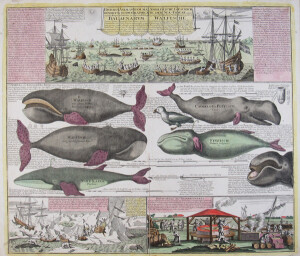 | NOTES: Hand-colored engraving titled 'Historia Animantium Marinorum Iconographica...' published by the Homann Heirs in the mid 18th century. There are four sections on the plate: 1. Whaling scene in Arctic., 2. Six types of whales, a sea louse, sea worms, a sea bird and several harpoons., 3. Whaleships trapped in the ice., 4. Try-works on shore. Each illustration is accompanied by a lengthy description in Dutch. The images are drawn from the writings of whalers Friderich Martens (1635-1699) who published 'Spitzbergische oder Groenlandische Reise-Beschreibung, gethan im Jahre 1671' in 1675 and Cornelius Gisbert Zordrager (ca 1660-1720) who published 'Beschreibung des Gronlandischen Walfischfang' in 1750. 'Cum Privilegio S. Caef. Maj. Gratiosissimo,' under the title, is a Latin legal phrase meaning "with the most gracious privilege of His Sacred Imperial Majesty". It indicated that the Holy Roman Emperor granted the publisher legal protection against unauthorized copying. NOTES: [Description from page 228 of Whaling Prints in the Francis B. Lothrop Collection by Elizabeth Ingalls] From: Natur-und Kunstatlus, Nuremberg: Homann heirs, ca. 1760. Herauugegeben in der Homaennischen Handlung A. 1752. (published by the Homann booksellers in 1752.)] *The Homann family were prolific mapmakers and publishers in Nuremberg from 1702 to 1813. The family firm was established by Johann Baptist (1663-1724), then carried on by his heirs. Variations in the spelling of Homann occur in Spanish, French, and Latin. There are 3 known Homann prints showing whales and whaling scenes. The other two were published as a pair illustrating the natural history of the animal. (LE 330 and LE 331) [Translation of title panel] (...particularly the whale. First a special introduction in which the whales are pictured before you, according to their species, figure, size, feeding, capture of the whales, the preparation of the whalebone and blubber, and other curious happenings in the Polar Sea. All is extracted from the valuable book of travels of Fr. Martens, Zordrager, etc. and published for the amusement of nature lovers and contributed by the Homann heirs. With the gracious permission of his sacred majesty.) Four Sections: [top:] Beschreibung des Wallfisch-Fangs...(Description of the whale fishery). This scene is a copy of Plate A of Martens 1675 (Ingall's, Cat. 137). It is keyed a-r, differently from the original Martens plate, with the explanations on the side panels. [center:] Die Walfische oder Eilaendische Fische...(The Whales or island [Spitsbergen] fish). The three whales on the left, the whale louse, sea worms, lance, and harpoon are all from Pl. Q of Martens, (Ingall's, cat. 445). The three whales on the right are from Zorgdrager 1720, pp. 7, 81, and 162 (Ingall's, cat. 373, 374, 375). These have not been copied exactly, however, as the taxonomy is rather confused and incorrect. A Nord Kaper is a right whale, not a Physeter (sperm whale). And a Finfisch is the fin or finback, Balaenoptera physalus, not Balaena vulgaris, which is the common, bowhead, or right whale and does not have a dorsal fin. [lower left:] Weil die Walfisch sich gern unter die Eis-Felder...(Because the whales like to hide under the ice fields, the ships have to sail on the ice). This scene depicting the ships caught in the ice is a copy of Pl. B of Martens, 1675 (Ingall's cat. 137). [lower right:] Beschreibung der Tranbrennerey...(Description of the tryworks). The blubber is packed in barrels in the arctic to be dried out upon the return home. This scene, possibly of Hamburg, is from neither Martens or Zorgdrager. ROUGH TRANSLATION: [Panel 1] (at top center of title panel in Latin and German) Illustrated history of sea animals particularly the whale. First a special introduction in which the whales are pictured before you, according to their species, figure, size, feeding, capture of the whales, the preparation of the whalebone and blubber, and other curious happenings in the Polar Sea. All is extracted from the valuable book of travels of Fr. Martens, Zordrager, etc. and published for the amusement of nature lovers and contributed by the Homann heirs.; (key panel at top left) Description of the whale hunt: a) There are large ice fields. The sea ice is not smooth and has a color resembling blue vitriol. (b) One sails in between the large ice fields, secures the ships to them, and (c) posts lookouts. (d) When a whale is spotted, it is pursued in shallops. (e) The harpooner throws the harpoon at the whale; this is often done from two shallops. The harpoon is thrown—whenever possible—at the blowholes, and the action is often repeated two or three times. (f) The harpoon is attached to a line that runs back to the shallop, where (g) it can be paid out or hauled in by the line-handler in the line-well, as necessity dictates. (h) When the whale realizes it has been struck, it dives toward the ocean floor; the harpooner must then check if the line is being pulled too taut—so that it can be slackened—to prevent the entire shallop from being dragged down by the whale, which rushes away with great speed. (i) If the line goes slack, however, the line-handler must haul it in, taking care that it does not become tangled. (k) If the whale is not properly struck by the harpoon, it raises its tail and escapes. Consequently, the best time to strike is when it is spouting water, as it cannot hear anything at that moment. (l) The whale also escapes if it swims beneath an ice field for several miles, as the line must then be cut, forcing one to abandon the whale along with the harpoon and line. (m) The whale wounded by the harpoon; (at top on left side of image panel) A ship 110 to 118 feet in length. It must be very sturdily built—more so than other ships—due to the danger posed by the ice; it carries 50 harpoons and an equal number of lances, along with 60 whale lines, each 125 fathoms long and weighing 75 to 80 pounds. Each such ship carries 47 shallops (X), each manned by a crew of 28 to 50 men. Upon completion of the whaling voyage, a ship's cargo amounts to 600, 700, or even 800 Quartelen of blubber. The ship and its shallops are collectively referred to as a Fluyt.; (key panel at top right) After having turned the water completely bloody and exhausted himself by thrashing about, he rises again from the depths and is stabbed to death with lances (n). The steersman must constantly control the shallop and keep the harpoon line taut (o). The dead whale’s tail is cut off, and it is towed to the large ship by four or more shallops (M)—a process known as towing. Here, it is lashed to the ship, and the "cant piece" (a large strip of blubber) is first stripped down from the head. Once detached all around, this strip of blubber extends from the water below up to the crow's nest, allowing one to estimate the whale's thickness (p). The whale is hoisted upward, suspended by a strip of blubber attached to the crow's nest, while simultaneously being wound further up as more blubber is removed; the blubber is then cut by the "blubber-cutters" into distinct pieces, each half an ell in length. These pieces are cut into smaller sections on a table and packed into barrels or casks. Once all the blubber has been removed, the baleen is also hoisted up in one piece to be cleaned and cut back home. The remaining carcass is left to the scavenging birds (q); this refers to a fatty substance the whale sometimes exhales, which is consumed by fulmars (r). Fulmars often appear in such great numbers that they can be beaten to death with sticks.; [Panel 2 at middle, text from left to right and top to bottom] (at top left corner) Whales—or "island-sized fish"—do not spawn; instead, they give birth to two or three young, which they suckle with milk. During mating, they raise their heads out of the water; possessing very hot blood, they seek out cold regions—specifically latitudes between 70 and 80 degrees. They have a layer of yellow blubber six to twelve thumbs thick, and a layer an ell thick on the underbelly and beneath the lips—enough to fill 50 to 80 Quartelen (casks holding two Eimer each). Leeuwenhoek speculates that these creatures can live for a thousand years or more.; (on whale at top left of panel) (a) Whale with open gullet (Balaena propria); (at top of panel to left of center around image of sea louse) A whale louse—a creature resembling a sea crab—lodges itself between the fish's lips, fins, and genitals, biting out entire chunks of skin.; (at top of panel at right) (g) The sperm whale lacks baleen but is equipped with teeth. It inhabits the waters of the Indies and is notable because spermaceti—a substance once mistakenly thought to be whale semen—is derived from its massive head. In 1723, twenty-one of these whales strayed into the Elbe River; a large quantity of spermaceti was subsequently produced from their brains. Scale: 42 Rhenish feet. (under scale); (at top right corner of panel) tooth of a pot fish, 52 of which are found in the lower jaw. (over tooth), ½ Rhenish feet. (to right of scale); (at top center of panel over bird) A seabird known as the *Mallemucke* lives off whale blubber in the waters of Spitsbergen—whether from a dead or a living whale—and its presence often betrays the whale's location. It gorges itself until it collapses. It croaks like a frog. Its back and wings are gray, while its head and belly are white.; (on whale at top right) Sperm whale (Cetacean) (g); (under tail of whale at top left) (b) Here the fish blows water out of two bladder holes, so that it roars like a roaring wind, and can be heard for a mile. This roaring is even more terrifying when it is wounded, in which case it also bleeds out its own blood.; (to left of whale at center left) (d) The tail is 3 to 4 class wide. It lashes out powerfully when it feels rough, and also when it is speared, so that the boats have to be very careful not to be hit and shattered into a thousand pieces. The tail and fins are marbled, the skin of the rest of the body is blackish and smooth, white under the belly.; (over tail of whale at center left, discussing worms) (c) Sea worms, etc. The carcasses of whales, which he swallows at once in the thousands, are unsalted, fatty, and taste like fish oil. He also needs much other such small debris for his diet.; (on whale at center left) WHALE with closed mouth; (over whale at center right) (h) The fin whale is as long as the right whale but not as thick; it is faster in its movements and therefore more dangerous to catch. The fins on its back distinguish it from the right whale. Like the right whale, it spouts water from its blowholes, but with greater force. Because it does not yield enough blubber, it is not hunted extensively. Its upper jaw is also lined with baleen. Its diet differs from that of the right whale, consisting mainly of herring and cod. Its blood is not as warm as that of right whales, and it does not frequent the extremely cold waters near the poles, preferring instead to inhabit somewhat more distant and warmer waters.; (on whale at center right) FIN FISH (Balæna vulgaris) (h); (under tail of whale at center left) (a) The eye of the whale is no larger than that of an ox and is furnished with eyebrows. During dissection, Leeuwenhoek found it surrounded by a firm substance and concluded that this was necessary due to the immense pressure of the water; for calculations show that with a water column 8,400 feet high—the depth to which a whale often dives—each cubic foot of seawater (weighing 66 lbs) would be subjected to the pressure of 554,400 lbs of water, meaning the eye would have to withstand a load of 23,200 lbs. The horny skin could be separated into 18 distinct layers.; (at center over scale and harpoon) Scale for the fin-fish of 54 Rhenish feet; a lance 2 fathoms or 12 feet long.; (under body of whale at center right and over scale) (i) Open mouth of a whale, showing the arrangement of the baleen plates.; (on whale at bottom left corner) North Atlantic right whale (Physter) (e); (under whale at bottom left corner) (e) This fish frequents the waters off the North Atlantic and Iceland, seeks the deepest water, and feeds on herring, cod, and similar fish. It is of a colder nature than the whale; furthermore, instead of teeth, it has baleen plates in its mouth extending down to the throat.; (at bottom center above and below harpoon) A harpoon with its wooden shaft, which is attached to the socket (l). The shaft or pole is 8 or 10 feet long. This leading rope (k) is made of the finest hemp and is 36 feet long; it is called the "forerunner," and the whale line is attached to both its ends. About 14 sections of line are used—that is, a rope 1,400 fathoms (or 8,400 feet) long—to allow slack for the whale as it dives toward the ocean floor.; (to left of whale mouth at bottom right corner) The baleen plates are situated in the upper lips and throat, extending down to the gullet. These plates are broad, long, horny strips, fringed with hair at their ends. There are about 500 of them on each side, the largest measuring 10 to 12 feet in length. It is from these plates that the baleen is cut and whalebone prepared; together with the gums, they weigh 1,200 pounds. They serve the fish in place of teeth, ensuring that when the mouth closes, the water scooped up with the prey drains away while the prey itself is retained. The hairs on the plates protect the tongue from any injury caused by the plates themselves.; [Panel 3, bottom left corner] (at top center) Because whales like to hide beneath ice fields and floes, ships must sail into the ice; however, during a storm, the floes pile up upon one another (A) to such an extent that they stand like mountains. Consequently (B), a ship is often crushed by them—or even pulled underwater—forcing the crew to flee onto the ice fields (C). The ice extends as far as the eye can see across the sea (D). A polar bear stands atop a dead whale alongside fulmars, feeding on the carcass.; (at top right corner) A piece of ice measuring two or more miles in length is called a "field." Ice floes smaller than two miles across are known as "fladen" (floes); smaller ones still are called "schotzen" or simply loose ice. When a whale dives beneath the large ice fields, it must soon resurface to breathe, making the hunt proceed successfully; conversely, among the floes and smaller fragments, there are many openings where the whale can more easily elude its enemies.; [Panel 4, bottom right corner] Description of the TRYWORKS. When the whale blubber has been brought to the blubber distillery in quarters, the pieces of blubber (a), cut into finlets in Greenland, are placed in the copper pan (b) and stirred while boiling (c) until, after 3 hours of boiling, the fat can be scooped out with spoons. This fat runs down the canal into the trough (d) equipped with a grate, from where it flows into two other troughs filled with 1/3 water and cools. From the alfalfa, the cooper fills it into the barrels (e). One whale yields 45-50 such quarters of blubber.; NOTES: The Homann family were prolific mapmakers and publishers in Nuremberg from 1702 to 1813. The family firm was established by Johann Baptist (1663-1724), then carried on by his heirs. Variations in the spelling of Homann occur in Spanish, French, and Latin. There are 3 known Homann prints showing whales and whaling scenes. Two were published as a pair illustrating the natural history of the animal (see LE 330 and LE 331) titled Historia Animantium Marinorum Iconographica in 1752. NOTES: Nantucket native William F. Macy learned the printer’s trade at Nantucket’s newspaper, ‘The Inquirer and Mirror.’ After going to the mainland he worked in several printing shops around Boston and was appointed as the first instructor in printing at the Lyman School for Boys in Westboro, Massachusetts. Later Macy opened an insurance agency in Boston. Throughout this time he continued studying Nantucket history and frequently contributed articles to ‘The Inquirer and Mirror’ (signing his articles "Yorick"). Around 1912, in collaboration with Anna Gardner Fish and Roland Bunker Hussey, Macy issued the first edition of the "Nantucket Scrap Basket". He arranged for a second edition of this publication in 1932. In 1915, Mr. Macy prepared and published "The Story of Old Nantucket," a condensed history of Nantucket (reprinted in 1931). He was a founder and one time president of "The Sons and Daughters of Nantucket." In 1924, Macy was appointed President of the Nantucket Historical Association and served until his death in 1935. During this time Edward F. Sanderson approached the Association about receiving his collection of whaling paraphernalia with the purpose of establishing a whaling museum on Nantucket. When he returned to Nantucket in 1928 Mr. Macy purchased the old American House property, on the corner of Orange Street and Martins Lane, and built the house now standing there. This became Macy’s headquarters during his decade of planning, raising money and finally establishing the Nantucket Whaling Museum which opened its doors on July 24, 1930. NOTE: There is one (1) unaccessioned duplicate. | CL10726 |
Created 2026 by Don Barker, CBMM volunteer, for the Chesapeake Shipbuilding Project. shipbuilding@sailingworkboats.es